Hijack Marketing: How Brands Conquer In The Name of Politics
Hijack marketing gets attention. As traditional marketing tactics continue to evolve, we analyse the upward-rising trend of brands hijacking political events.
What is hijack marketing?
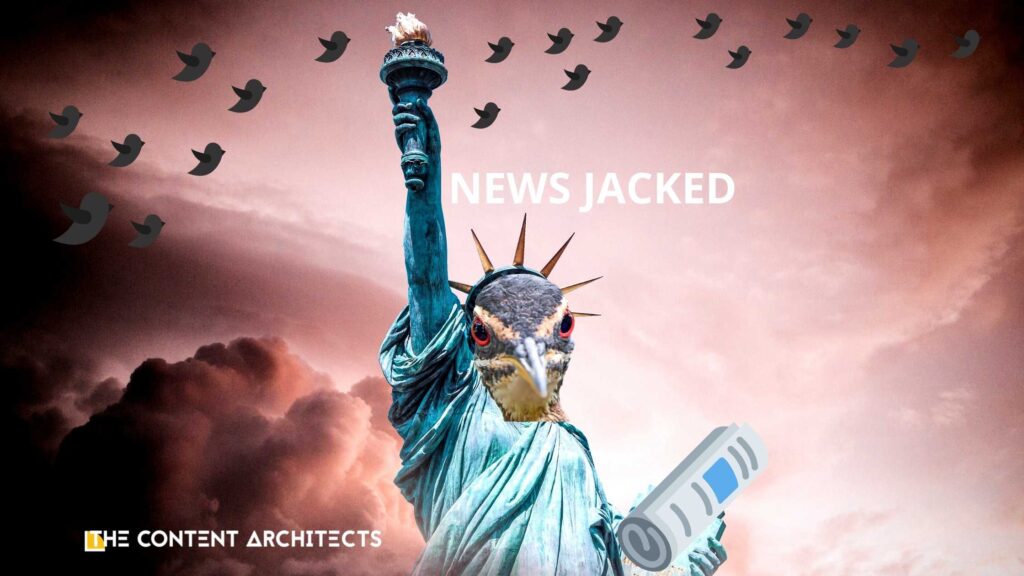
Hijack marketing refers to the practice of brands affiliating themselves with current events or topical conversations. It is a method employed by marketers to take advantage of a pre-existing audience ripe for discussion. The idea is for brands to tap into the buzz and join the dialogue, harnessing the publicity to improve, say, corporate image, or, drive up sales.
A sharp-witted response to a subject trending on social media – see Oreo’s infamous ‘You Can Still Dunk In The Dark’ tweet during the 2013 Super Bowl – is a form of hijack marketing, and so too is an advertising campaign that implicitly (or, in rarer cases, explicitly) comments on contemporary socio-political developments (or movements): the rise of the Black Lives Matter movement or Brexit, for example.
Why are brands increasingly inspired by politics in their hijack marketing endeavours?
A golden and oft-repeated rule of marketing used to be that politics should be avoided at all costs. It was a taboo subject. Brands feared that taking a stand could alienate vast swathes of their consumer base: a policy of non-intervention appeared the best course to take.
Yet, in recent years we have started to demand more from our favourite brands. A 2018 investigation conducted by Sprout Social found that 66% of consumers believe it is important for brands to take public stands on political and social issues. In the same year, another study established that nearly two-out-of-three consumers worldwide are now belief-driven buyers, willing to switch, boycott or avoid a brand based on its point of view on societal issues (Edelman Earned Brand, 2018).
In 2020, CEO of Goya Foods, Robert Unanue, prompted calls for a widespread boycott of his own company after he was seen singing the then-president, Trump’s praises at a White House event. #Goyaway was trending on Twitter, where people collected to encourage other consumers to avoid the brand and shun Unanue.
The consensus is that neutrality is no longer a viable option, and that in an increasingly polarised society, brands are faced with the difficult prospect of publicising their political views. Richard Edelman, President and CEO of the public relations and marketing consultancy firm, Edelman, captures the mood: “Brands are now being pushed to go beyond their classic business interests to become advocates”.
Marketers Want to Appeal to Generation Z and Politics Is One Way
One reason for the increasing politicisation of marketing in recent years is the coming-of-age of Generation Z – loosely, those born between 1995 and 2010. We might think of this demographic cohort as the tech-savvy, inter-connected and politically engaged young adults of today. Four years ago, MNI Target Media forecasted that by 2020 Generation Z would account for almost 40% of all consumers worldwide. As such, it is pivotal for companies to register their values and behaviours, or risk marginalising one of the most powerful factions in the market.
So what exactly distinguishes Generation Z as buyers? According to a report by McKinsey & Company, they are more likely to view consumption as a ‘matter of ethical concern’, believing that brands should be transparent in their operations and engage with issues relevant to their identity (a good example would be the outdoor clothing company, Patagonia, and its sustained environmental activism). Generation Z is also twice as likely to maintain that brands should use their influence to impact cultural matters than Boomers – individuals born during the post-World War Two ‘baby boom’ (Morning Consult and Advertising Week New York, 2019).

What are the risks involved when brands take on political marketing hijacking?
While a calculated and well-timed political stunt might attract a lot of media attention, see stock prices rise and entice future employees with like-minded convictions, there is almost always a trade-off. Entering the political fray is like crossing the Rubicon for a brand. Once an opinion becomes public knowledge it naturally follows that consumers with a contrasting perspective can feel alienated. This undermines brand loyalty and can lead to the boycotting of products or services. In 2018, Nike faced online backlash after releasing an advert endorsing Colin Kaepernick – the NFL player who knelt during the national anthem to raise awareness of racial injustice and police brutality – with Twitter users posting videos of themselves burning Nike shoes and spreading the hashtag #NikeBoycott.
There is also the sticky question of authenticity. Brands do not want to be seen commercialising injustice by co-opting a movement or issue. Those faking social commitment and taking a convenient position for monetary gain will be exposed. Corporate advocacy should be transparent, bona fide, and in line with a brand’s story and world-view.
Failing to practice what you preach is another sure way for political hijack marketing to turn sour. A company that appropriates a popular movement in its marketing efforts must be sure that its own operations are in order. If it launches an advertising campaign in support of gender equality, for example, the spotlight will soon be turned inward. Should stories of misogyny in said company’s workplace arise, the press is sure to latch onto them and cause a PR storm.
Twelve hijack marketing campaign examples of brands who hijacked in the name of politics (in no particular order)
1. Brand BrewDog capitalise on a political blunder.
Back in April 2021, Boris Johnson’s chief aide, Dominic Cummings, landed himself in hot water when he was spotted flouting government lockdown rules. The political strategist later admitted to undertaking a 52-mile round trip to Barnard Castle, County Durham in order to test his eye-sight, much to the dismay of the British public.
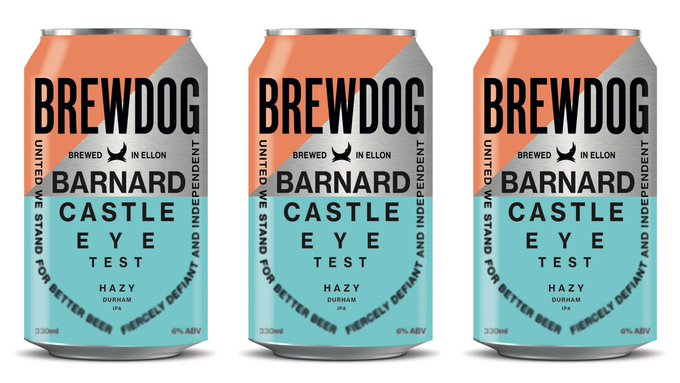
Scottish beer giant BrewDog – no stranger to bold marketing stunts – hijacked the moment by releasing a limited edition ‘Barnard Castle Eye Test Hazy IPA’. It was described as ‘a short-sighted beer for tall stories’ and the design of the can mimiced an opticians’ letter chart.
A tweet announcing the IPA’s pre-sale was retweeted over 9,000 times and liked by 24,000 users. The product raised £200,000, with all proceeds going towards BrewDog’s production of free sanitiser for the NHS and health care charities.
2. Drink Brand Budweiser’s immigration focused Super Bowl ad unsettles America’s conservative right.
The Super Bowl is watched by millions of viewers worldwide and ads streamed during the game have become a cultural phenomenon in their own right. The 2017 Super Bowl saw Budweiser release a pertinent ad exploring themes of immigration, xenophobia and the American Dream. It depicted Budweiser’s founder, Adolphus Busch, and the adversity he faced in immigrating to St. Louis from Germany in the 1850’s, concluding on a positive note when he meets Eberhard Anheuser, his future business partner.
While some viewers took to social media to celebrate the brand’s pro-immigration message, it hit a nerve with staunch Republicans in support of President Trump’s executive order banning travellers from seven Muslim-majority nations. This led to the popularity of #BoycottBudweiser and #BoycottBud hashtags on Twitter.
3. Corporate Giant McDonald’s take on India’s low voting turnouts.
Inspired to curve the trend of low voting turnouts in India – 280 million of the 900 million citizens on the electoral register opted not to vote in the 2015 general election – McDonald’s embarked on a high profile #MakeYourChoice campaign as the nation went to the polls in 2019.
A social experiment ad aired in which staff served incorrect orders to youthful customers who had not yet exercised their right to vote. According to Arvind RP, Director of Marketing and Communications for McDonald’s West and South India, the message was clear: ‘If you don’t vote, you lose the right to choose’.
The initiative reached over one million Facebook users and was shared widely on other popular online platforms. All the while, McDonald’s painted itself as a socially responsible corporation invested in proper democratic practice and the youth of today.
4. Airline Aeroméxico join the growing list of Mexican brands hitting back at President Trump.
The anti-Mexican rhetoric spread by future US leader, Donald Trump, during his presidential bid was met with resistance by a host of influential Mexican companies, who sought to capitalise on the climate by defacing his policies in their marketing ventures. Aeroméxico, the nation’s largest airline, was quick to take a political stance.
It released an ad entitled ‘Fronteras’ (‘Borders’) that critiqued the divisive nature of society and championed human togetherness. The opening line: “Borders. Has anything good ever come of them?”, in particular, was a clear attack on Trump’s pledge to build a wall at the US-Mexico border.
Reaching 1.4 million hits on YouTube, the ad was well received online and helped to raise brand awareness. That said, an image soon surfaced of a problematic casting call from an earlier Aeroméxico advertisement. It requested that ‘individuals of dark skin tones’ should not audition. The revelation quickly dampened the message of inclusivity.
5. FMCG Brand Burger King’s general election-themed billboard is a social media hit.
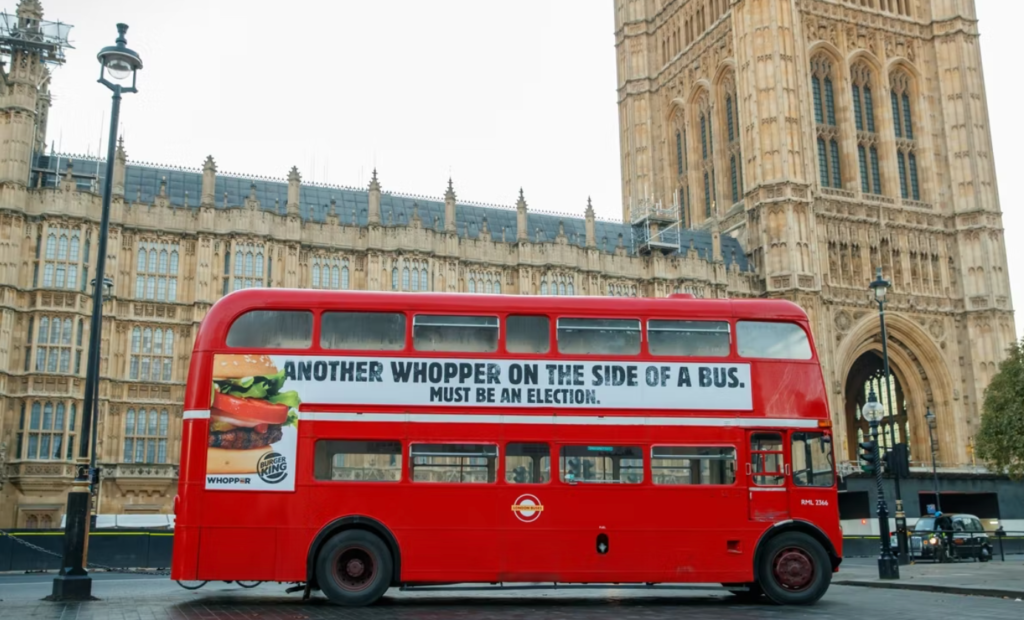
In the run-up to the UK’s 2019 general election, Burger King made its mark with a witty ploy that went viral. The fast-food giant parked a red double-decker bus outside of Parliament; it featured a billboard advertisement with the tagline: ‘Another whopper on the side of the bus’. Must be an election and an image of the iconic Whooper burger.
The playful wordplay looked back to a claim appearing on the side of Vote Leave’s battle bus during the EU Referendum, which suggested the UK was sending £350 million every week to the EU. It has since been criticised as misleading by, amongst others, Sir David Norgrove, chair of the UK Statistics Authority.
Burger King’s general election-themed marketing stunt was a big win. It drew attention to the act of politicians inflating figures in a tongue-in-cheek manner that really chimed with the British public. Pictures of the bus spread across social media, with Famous Campaigns, a Twitter account devoted to analysing marketing campaigns, tweeting: ‘Well played Burger King – election nonsense jacking at its finest’.
6. Drinks Brand Pepsi appropriate social justice movements in marketing their product and get it horribly wrong.
Now onto perhaps the ultimate political marketing bluff. Back in 2017, Pepsi paired up with Kendall Jenner to release a social protest ad. It showed her joining a group of youthful demonstrators, eventually approaching a line of police officers and handing one of them a can of Pepsi: an act that instantly improves relations between the two parties.
In the context of rising police brutality in the US, it was extremely wide of the mark. Viewers took to the internet in anger, pointing out how Pepsi had appropriated imagery from social justice demonstrations in the name of profit and trivialised the Black Lives Matter movement.
The brand released an official statement apologising for any offence caused and the ad was pulled from their YouTube channel within 24 hours.
7. Bristol Gin miss the mark in what was branded an insensitive trivialisation of the George Floyd protests.
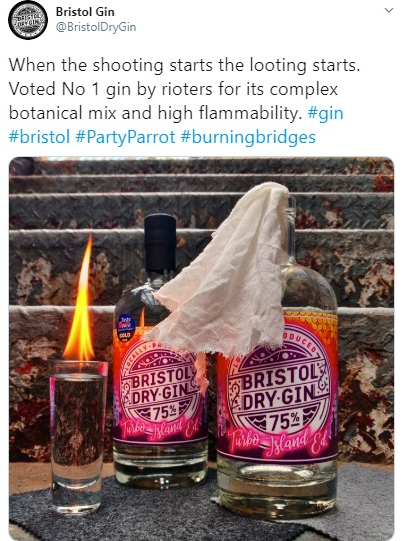
In a similarly tone-deaf attempt to establish their place in trending discourse, Bristol Dry Gin published a tweet that appeared to mock the widespread protests across the US following the murder of George Floyd.
In May 2020, George Floyd was restrained and killed by a Minneapolis police officer, who kneeled on his neck as Floyd pleaded that he could not breathe. In response to the protests that ensued, the then-president Trump published a tweet calling the protesters “thugs”, and echoed a phrase previously used in 1967 by Police Chief Walter Headley, in reference to his aggressive policing policies in black neighbourhoods: “when the looting starts, the shooting starts”.
Bristol Dry Gin showed their product prepared as a Molotov cocktail, jokingly promoting it as a highly flammable gin for rioters. Many stockists pulled the brand from their shelves, and consumers encouraged a boycott of the company. The brand apologised and said they had donated to Black Lives Matter, but blunders like this are hard to come back from.
This wasn’t the first time the company came under fire for making light of a serious tragedy. Back in 2018, they released a range of vodkas called ‘Novichok Edition‘, referencing the Salisbury Novichok poisonings.
8. Shaving Brand Gillette tackles toxic masculinity in light of the #MeToo movement.
Back in 2019, razor brand, Gillette, decided to make a spin on their famous slogan ‘The Best a Man Can Get’ in light of the #MeToo movement, and a growing concern of toxic masculinity. Their commercial, first aired at the Super Bowl that year, prompted viewers to ask instead, what is the best a man can be?
The #MeToo movement was at its height after a growing number of sexual-assault exposés were being revealed within Hollywood. These allegations, against high-profile figures like Harvey Weinstein and Matt Lauer, prompted wider discussions about the discrimination and abuse that women still face today at the hands of men.
Gillette used this advert to chime in on the discourse, exploring the stereotypes associated with manhood and masculinity, and prompting a reassessment of these values. Gillette’s search volume soared after the release of the commercial, and many praised the company for their address of this important issue.
9. American Airlines take a stance on the Supreme Court’s Marriage Equality decision.
Back in 2015, when the Supreme Court made the decision to extend full marriage rights to same-sex couples across the United States, American Airlines jumped on the opportunity to show their support.
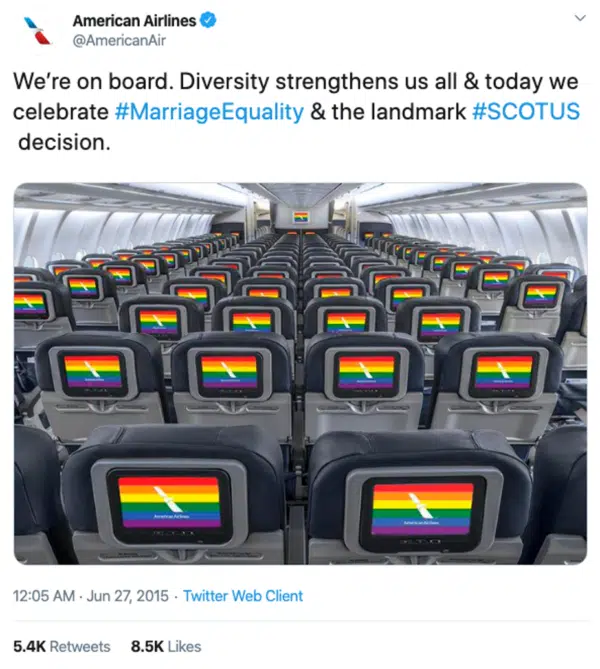
Prior to the landmark decision, American Airlines had joined a series of campaigns and pledges to support marriage equality, and has a longstanding reputation as an ally of the LGBT community. The company is officially recognised by the HRC’s Corporate Equality Index (CEI), a nationally recognised benchmark that highlights workplaces with a commitment to the inclusion of LGBT employees and their allies.
This is a good example of practicing what you preach – American Airlines may well have capitalised off trending discourse surrounding a serious social issue, but they have a history of commitment to the cause to back it up. Thus avoiding any claims of shallow virtue signalling or ‘wokevertising’.
10. Paddy Power’s ‘Brexit Bunker’ sketch with Eric Catona.
In 2019, Irish bookmakers, Paddy Power, released a satirical advertisement featuring Eric Catona, whom pokes fun at the mess of Brexit. He is seen making reference to ‘Piggate’ (the allegations of David Cameron’s sordid relations with a dead pig at university), as well as mocking Theresa May’s infamous dance moves, and Boris Johnson’s hair.
The campaign, which went viral after its release, offered registered players of Paddy Power the unique opportunity to spend two nights in the ‘Brexit Bunker’ off the coast of Portsmouth, as a means of escaping the political carnage of Brexit. This humorous competition tapped into the nation’s exhaustion with UK politics and the incessant chaos of Brexit discussions.
As Brexit dominated public discourse, many brands competed for space in the conversation. HSBC ran a similar advertising campaign titled ‘We Are Not An Island‘, which alluded to a more subtle critique of Brexit.
11. UK energy drink company pokes fun at lockdown confusion.
In yet another clever attempt to tap into the UK’s frustration with the political elite, energy drink company, DRGN, released a series of poster advertisements mocking the prime minister’s confusing guidance on lockdown rules.
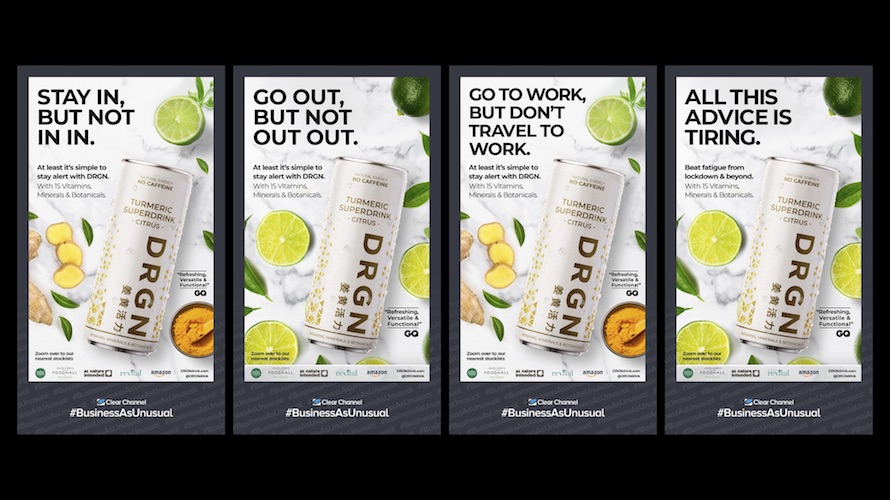
Under the tagline ‘all this advice is tiering’, DRGN used wit and humour to promote their product as a means of ‘beating lockdown fatigue’ and combatting ‘the stressors of modern life’. The headline quips make reference to Boris Johnson’s speech in May 2020, when he announced the easing of lockdown rules across England. The announcement prompted an onslaught of criticism and memes, which branded the speech a jumbled mess of contradiction and confusion.
12. Mediation App Calm’s simple but effective sponsorship of US election night coverage.
During the US presidential elections of 2020, meditation app, Calm, formed a strategic partnership with CNN, who allowed them to sponsor the night’s live news coverage of the election race. Calm ran an advertisement in the middle of CNN’s “Key Race Alerts”, featuring 30 seconds of rain falling on leaves. At the same time, the brand was sharing breathing and relaxation exercises on social media.
Although technically, the brand simply paid for an advertising slot on a prominent news network (not newsjacking), it was their clever timing and witty placement that saw them hailed as a great example of capitalising off the headlines. It was seen as a troll on how stressed and anxious Americans were getting surrounding the presidential race. Calm saw a 248% increase in Twitter mentions on the day of the sponsorship, and their downloads soared in response to the stunt.
Neither CNN nor Calm would disclose how much the app paid for the deal. However, recent data shows the sponsorship may have ultimately paid off. Calm was downloaded about 35,000 times on Nov. 3 and again on Nov. 4, up from its daily average of 26,000 downloads the week prior, according to data from mobile app data analytics firm Sensor Tower.
Three tips for brands looking to hijack political events:
- Be consistent with your brand identity. One reason why the aforementioned Pepsi ad failed to strike a chord with viewers is because it felt inauthentic. In contrast, Airbnb’s #WeAccept campaign – heavily focused on integration and connection – was a success in that it resonated with the company’s mission and ethos.
- Know your target market. Brands that understand their consumer will be better placed in predicting how they respond to topical developments. They can then adjust their hijack marketing efforts accordingly to maximise positive responses.
- Do your research before you hijack in marketing. Eliminate the risk of looking ‘out of touch’ or insensitive by analysing the wider context of events and issues. This will also help brands to decide if it is best to get involved or stay quiet on a matter.
- Track key events coming up in the political calendar: Some events you can plan for, and others you need to be quick and react. For planning, you can use our tool to stay ahead of political moments taking place- our key dates finder platform tracks anticipated elections and political dates in the diary. Or check out our article to see what is happening in the political world in 2022.
Written by Jordan Brunel, Updated by Becky Tudor