With modern working lifestyles threatening to become all-consuming, self-care has never meant so much…
You wouldn’t have to backtrack many years to find a time where the dialogue around mental health was mute. In the past decade, open discussions about our emotional wellbeing have become commonplace, and rightly so, leading to a new priority framed as ‘self-care’. Self-care refers to self-imposed actions that encourage positive physical and mental health.
Initially started in 2011 by the International Self Care Foundation (ISF), the national awareness day has taken on a global presence, as countries across the world begin to embrace the importance of caring for ourselves.
According to the ISF website, International Self Care Day, which takes place annually on July 24, is designed to ‘raise the profile of healthy lifestyle self-care programmes around the world’.
The date was cleverly chosen to symbolise the on-going need to prioritise wellbeing ‘24/7’ – the 24th signifying 24 hours a day, and July, the 7th month, 7 days a week. The benefits of self-care should be life-long, and not just relegated to one single day. International Self Care Day (ISD) activities now spread across continents, from Bangladesh to Brazil, South Korea to South Africa.
Global differences for Self Care Days
It should be noted that both the UK and Canada have a separate week dedicated to self-care. The UK’s week is run by Self Care Forum and is backed by the NHS (local healthcare provider), and takes place every November.
International/ National Self Care Day attracted so much attention that in 2019, the World Health Organisation announced that Self Care Month would begin on 24th June, and end on 24th July, to coincide with International Self Care Day.
The rise of mental health awareness, pre & post COVID
Nowadays, our busy schedules along with the pressure to juggle any combination of studies, careers, families and social life, mean that it’s become all too familiar to prioritise every aspect of life other than your wellbeing. Self-care can translate into any number of actions, bringing physical and mental wellbeing to the forefront.
The breakout of Covid-19 towards the beginning of 2020 has also furthered the mental health discussion, with two contrasting scenarios emerging. On the one hand, we have those who’ve suddenly acquired more free-time in which they can focus on doing things that aid their mental and physical health, and towards the other extreme, we have a group of people having to face newfound responsibilities and pressures such as home-schooling, caring for vulnerable, heightened health concerns, and economical instability. This realisation of the unexpected twists and turns that life can spring upon us, has, according to Mintel.com, ‘impacted how adults prioritize personal wellness,’ which in turn is ‘forcing companies and brands to re-evaluate their approach’. The Mintel report highlights how incorporating wellness activities at home or across outdoor spaces has become essential in a bid to ‘maintain connections, release newfound stress and recuperate some semblance of normalcy’.
Looking forward to a post-lockdown society, many adults are actively thinking about how they can progress their self-care routines in order to continue the focus on their wellbeing. According to Gracie Page, of Y&R advertising agency, London, our increasingly fast-paced lifestyles, along with raised awareness of mindfulness, means that people are putting more consideration into how they can take charge of their mental and physical health and that these changes are reflected in the consumer approach, which every brand should be taking into account – not simply those who play an obvious role in the wellness industry.
2015-2020 Google Trends, US, searched for Self Care (notice peaks)
Brands taking on self-care – ‘But I don’t even know where to start…’
For customers unsure of how to take on what can seem like the mammoth task of reassessing their own needs, brands can help.
Many brands are aware their audiences are stressed and overworked. Bringing this into your marketing plan not only fosters a culture of self-care; it also changes the relationship between the brand and your customer. The brand’s association with easy living and simplicity heightens- something which is becoming scarce in today’s world.
Bite-size self-care challenges
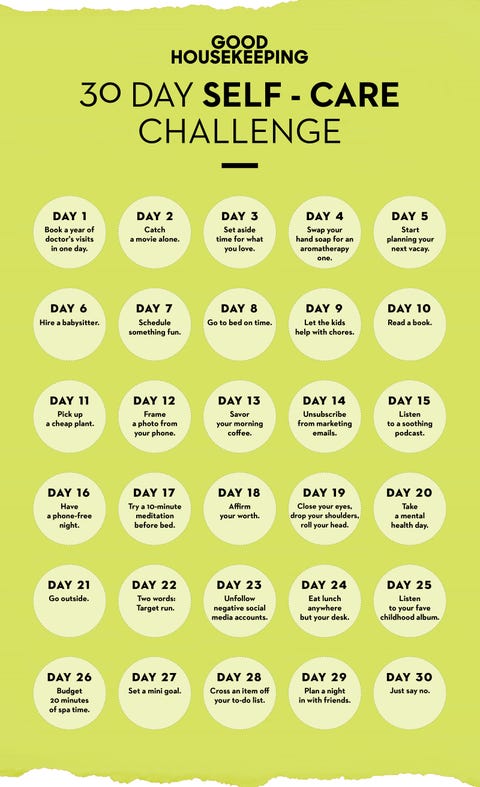
Self-care challenges have taken over social media and are a simple but effective place to start. Often, these challenges span 30 days, each day harbouring a different task. Examples of ‘challenges’ include going for walks with a friend, eating lunch away from your computer, writing gratitude lists, and ticking something off your to-do list. These encourage people to take manageable, non-daunting steps, to ensure they have at least one moment in the day where they prioritise themselves and do something fulfilling and/or calming.
💡- Make a Self-care challenge for your company, where colleagues can spur each other on and share how they met their daily challenges.
Goodhousekeeping.com – For Busy Mums
Not just an annual event – #SelfCareSunday
Despite the existence of an international awareness day, we must emphasise as with many days, that self-care shouldn’t be relegated to just one day. But it helps to have a reminder!
For this reason ‘Self Care Sunday’ has become a thing. Sunday is considered an ideal day to focus on ourselves. Why? Firstly, because Saturday is often set aside for social commitments, and secondly, as self-care on a Sunday can provide a calming influence on the coming work week. The likes of online cosmetics retailer Beauty Bay, and media outlets such as Glamour Magazine and Refinery 29 have all dedicated content and/or marketing campaigns towards this idea, and the hashtag ‘#selfcaresunday’ has even been used by Michelle Obama.
#SelfCareSunday
You can connect self-care to almost any offering; service-wise. Consider encouraging your audience to take time out to engage in new experiences, maybe you can offer something, or help them see things differently. If your audience is working to big goals like planning a wedding, improving their diet, writing a book, or amping up their sales strategy, look at how you can help them. People love having that responsibility lifted from their own shoulders.
How you can promote self-care within your company
Start small. Self-care certainly shouldn’t be overwhelming.
Emphasize the importance of self-care not just for the end-user but the impact it can have on those around them. This is vital for anyone struggling with self-esteem issues, as they could risk interpreting it as a selfish venture and give up along the way.
Explain how small steps can lead to bigger accomplishments
Think about the daily needs we all share, sleeping, eating, social contact, and financial.
Analyse routines. Can you offer healthy escapism or coping techniques? Or better still remove stress.
Remember everyone’s self-care routine will and should look different, based on individual needs, ages, etc. Each has its own concerns, worries and expectations. I.e. Millenials are often stressed about buying a home, the pressure to succeed.
Acknowledge mental health is important by weaving this into your content allows you to be more relatable, developing a deeper dialogue.
While women are often stereotypically put at the forefront of such campaigns, more and more men are ditching the taboo of speaking out. Is your audience predominantly male? Mintel again sums this up nicely ‘self-care is emerging as a genderless and fluid marketing platform…’.
Take advantage of social media channels. Instagram stories, Twitter polls are great starting points for checking in on consumers, keeps them engaged and coming back for more if they feel your brand offers a supportive environment.
Campaign: In 2015, Paraguay, Kit Kat created a bench which rewarded individual passersby with a free chocolate bar when the machine sensed they had taken enough of a “break” (of at least 60 seconds).
Campaign: Mcdonald’s via a social media campaign promoted their Premium Roast Coffee, where they equated buying one of their coffees to looking after yourself. Whether you agree with their concept or feel the link is tenuous, consumers do buy into the self-care ‘excuse’, in justifying and investing in products.
So what should you take from all of this?
Despite the significance of International Self-Care Day, this concept is applicable all year round.
International Self Care Day gives businesses an opportunity to assess what it is they offer to the audience and how they enhance lives. What is it that you’re offering that can aid them in their physical and mental wellbeing journey?
As businesses and consumers, we shouldn’t love self-care because of self-indulgence. The message that needs to be sent out is quite the opposite – the promotion of self-care is all about reclaiming our right to a healthy body and mind, allowing the time and space to free ourselves from the pressures that modern society brings, and help us live better lives.
Feeling inspired? Email us, or visit the contact page and let us know what you decided to run with, we would love to see!
Written by Mary Dulwich
Your inbox deserves great insights. Stay informed & on top of your game
SIGN UP TO THE BI-MONTHLY NEWSLETTER
There was an error. Please try again later.
Success! We just heard from your inbox, it can’t wait!